Command.java
package commands.schlecht;

public interface Command {
    String type();
}

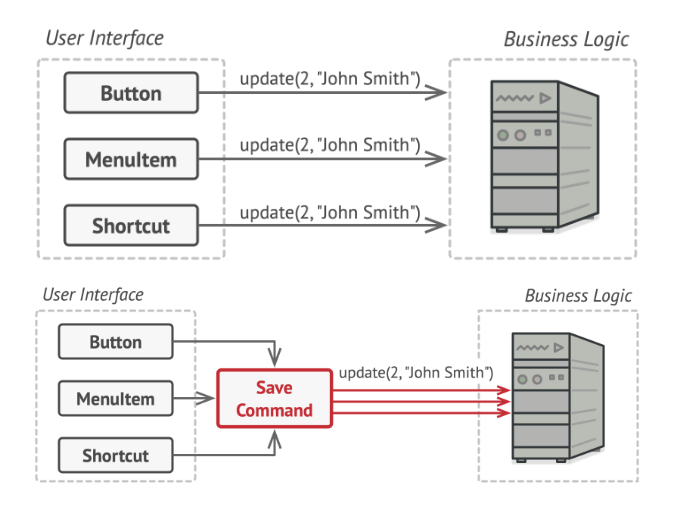
Command ist ein Verhaltensmuster, das Anfragen als Objekte kapselt.
Command.java
package commands.schlecht;
public interface Command {
String type();
}
CommandExecuter.java
package commands.schlecht;

public class CommandExecuter {

        public void executeCommand(Command command) {
            System.out.println("Executing command: " + command.type());
            switch (command.type()) {
                case "DELETE_TEXT":
                    System.out.println("Deleting text...");
                    break;
                case "INSERT_TEXT":
                    System.out.println("Inserting text...");
                    break;
							 // Immer weiter....
                default:
                    System.out.println("Unknown command type: " + command.type());
            }
        }

        public void undoCommand(Command command) {
            System.out.println("Undoing command: " + command.type());
			// Wie war der State???
        }


}
Trennung: Aufrufer und Ausführer einer Aktion werden entkoppelt.
Kapselung: Methode, Parameter und Empfänger werden in einem Objekt gespeichert.
Flexibilität: Aktionen können übergeben, verzögert oder rückgängig gemacht werden.
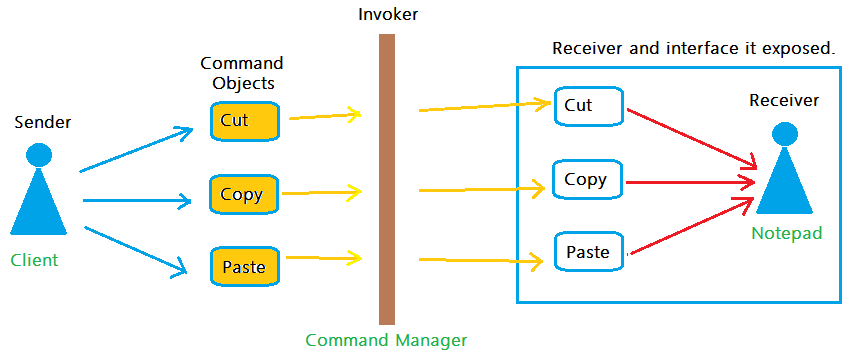
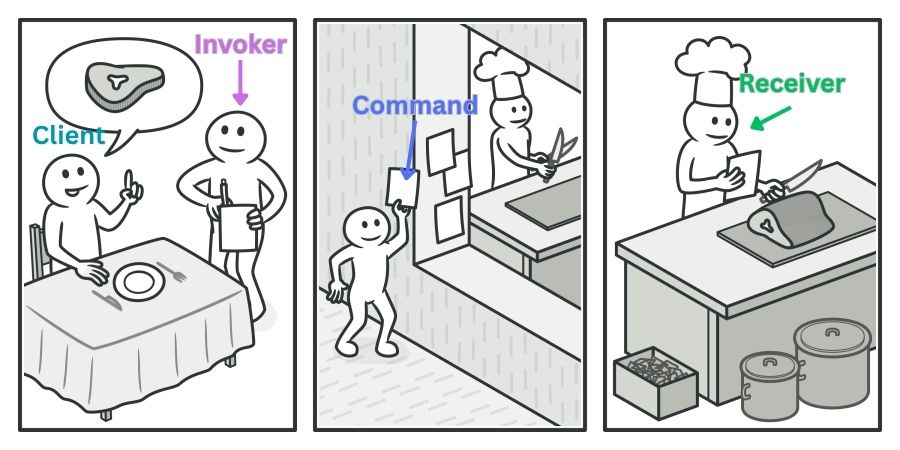
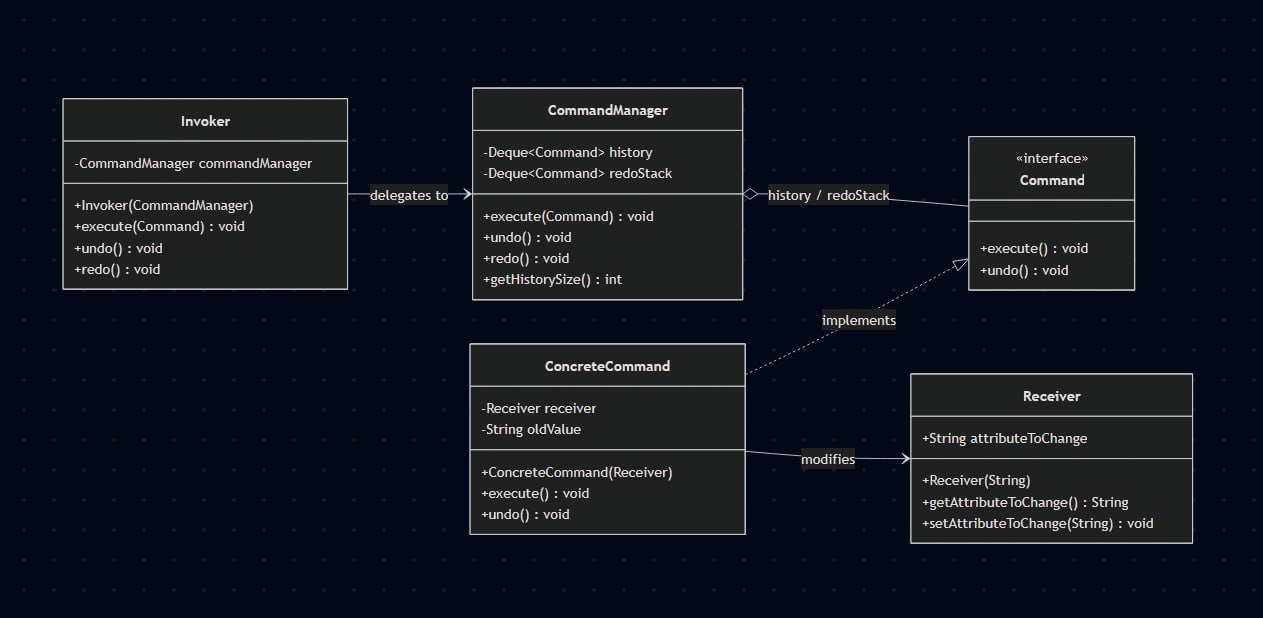
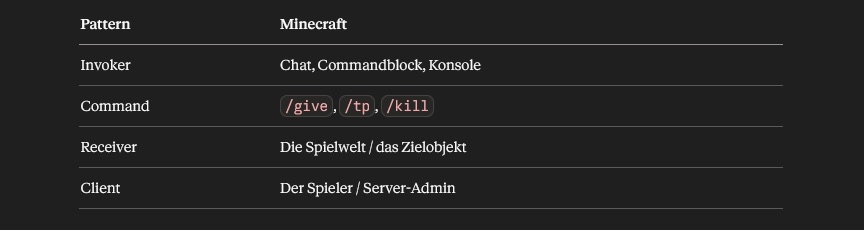
Command – definiert die Schnittstelle, meist execute().
Concrete Command – konkrete Implementierung einer Aktion.
Invoker – löst die Command aus.
Receiver – führt die eigentliche Geschäftslogik aus.
Client – erstellt und verbindet alle Objekte.
public interface Command {
    void execute();
    void undo();
}
public class InsertTextCommand implements Command {
    private final TextEditor editor;
    private final String text;
    private final int position;

    public InsertTextCommand(TextEditor editor, String text, int position) {
        this.editor = editor;
        this.text = text;
        this.position = position;
    }

    @Override
    public void execute() {
        editor.insert(position, text);
    }

    @Override
    public void undo() {
        editor.delete(position, text.length());
    }
}
public class CommandManager {
    private final Deque'Command' undoStack = new ArrayDeque''();
    private final Deque'Command' redoStack = new ArrayDeque''();

    public void executeCommand(Command command) {
        command.execute();
        undoStack.push(command);
        redoStack.clear();
    }

    public void undo() {
        if (!undoStack.isEmpty()) {
            Command command = undoStack.pop();
            command.undo();
            redoStack.push(command);
        }
    }

    public void redo() {
        if (!redoStack.isEmpty()) {
            Command command = redoStack.pop();
            command.execute();
            undoStack.push(command);
        }
    }
}
public class EditorInvoker {
    private final CommandManager commandManager;
    private final TextEditor editor;

    public EditorInvoker(CommandManager commandManager, TextEditor editor) {
        this.commandManager = commandManager;
        this.editor = editor;
    }

    public void onInsertButton(String text, int position) {
        Command command = new InsertTextCommand(editor, text, position);
        commandManager.executeCommand(command);
    }

    public void onUndoButton() {
        commandManager.undo();
    }
}
GUI-Komponenten: Buttons, Menüs, Toolbar-Aktionen.
Undo / Redo: Aktionen rückgängig machen.
Logging: Operationen speichern und erneut abspielen.
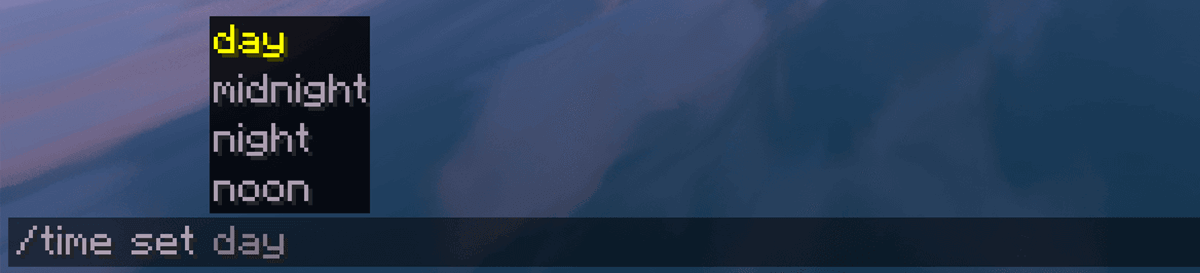
S (Single Responsibility):
Jede Klasse hat eine klare Verantwortung — invoker, receiver, command, etc.
O (Open/ Closed):
Neue Befehle können hinzugefügt werden, ohne bestehende Klassen zu verändern.
D (Dependency Inversion):
Aufrufer basieren auf Abstraktionen (Befehl- Schnittstelle) anstatt auf konkreten Klassen.
👍Entkoppelt Sender und Empfänger einer Anfrage.
👍Mehrere Software-Design-Prinzipen erfüllt.
👍Unterstützt Undo/Redo.
👎Es entstehen oft viele kleine Klassen.
👎Für einfache Projekte kann das Pattern zu komplex sein.
👎Undo erfordert sauberes Zustandsmanagement.
👎Große Command-Historien können Speicher verbrauchen.
👎Nicht jede Aktion mit Seiteneffekten ist leicht rückgängig zu machen.
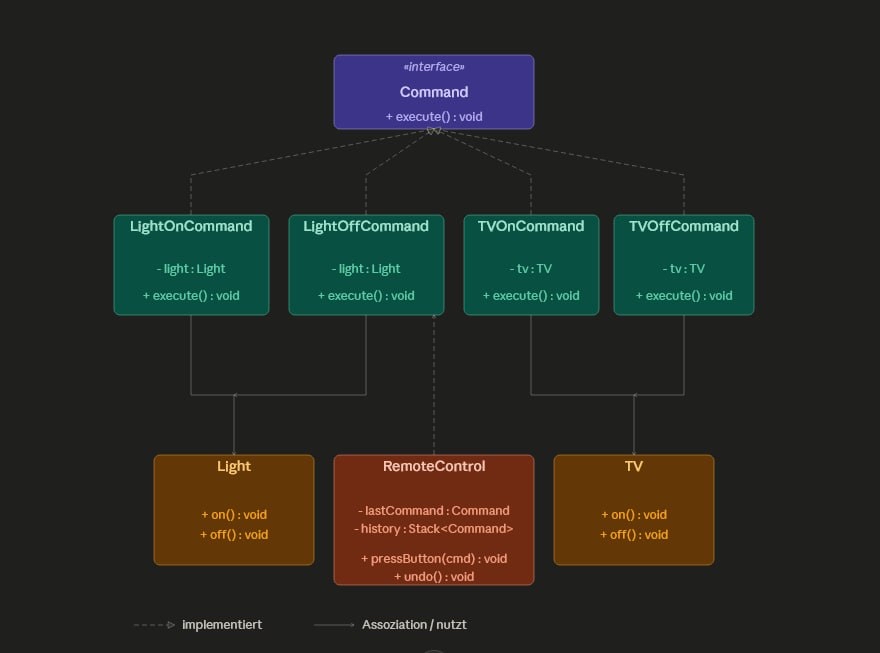
Es soll eine einfache Fernbedienung implementiert werden, die Folgendes kann:
Wichtige Anforderung: Die Fernbedienung darf nicht wissen, welches Gerät sie steuert. Sie drückt nur Knöpfe.
Zusätzlich: Neue Geräte sollen hinzugefügt werden können, ohne den Code der Fernbedienung zu ändern
Fragen?